
Many buildings in New Zealand were constructed with metal roofs installed at pitches lower than those allowed by the NZ Building Code today. Under NZBC Clause E2/AS1, the minimum pitch for profiled metal roofing is generally 3°, depending on the profile and manufacturer. However, older roofs were often installed at 1° to 1.5°, and over time this has led to ponding, backflow, capillary action, corrosion around fixings, and persistent leaks.
When a metal roof no longer meets modern pitch requirements and increasing the pitch is not practical, a membrane overlay system becomes one of the most effective long-term solutions. Instead of rebuilding the entire roof structure, a membrane system creates a continuous, watertight surface that performs reliably at very low falls, often down to 0.5°–1° depending on design and detailing.
Overview
This article outlines why low-pitch metal roofs commonly fail, why membrane overlays are often the better long-term solution, which roof types are suitable, and how insulation upgrades can improve overall building performance.
Why Low-Pitch Metal Roofs Commonly Fail
Low-pitch metal roofs experience several predictable problems:
- Ponding water due to insufficient fall
- Capillary ingress at laps and seam joints
- Corrosion around penetrations and fasteners
- Wind-driven rain forced into laps and joints
- Thermal expansion movement stressing flashings and junctions
- Multiple penetrations added over time, such as heat pumps and vents
On roofs installed decades ago, these issues compound as coatings wear away and fixings loosen. Once corrosion begins beneath the lap, water can travel long distances, making leak detection difficult and repairs increasingly unreliable.
When the underlying structure is still sound but the roofing surface is failing, replacing the metal system like-for-like is rarely the best long-term approach if the pitch still does not meet NZBC standards.
Why a Membrane Overlay System Performs Better
A membrane system creates a monolithic waterproof layer, removing reliance on laps, ribs, and capillary breaks.
Key advantages at low pitches
1. Suitable for falls below metal roofing limits
Since metal sheeting requires a minimum 3° pitch, low-slope roofs cannot remain code-compliant without redesign. Membranes perform reliably at very low falls and are widely used on the following building types:
- Commercial buildings
- Schools
- Supermarkets
- Apartment blocks
- Industrial structures
2. No exposed fixings or laps
Membranes are welded or bonded into a continuous sheet, eliminating many of the common failure points associated with metal roofing.
3. Strong UV and ponding resistance
Modern membranes are engineered to tolerate New Zealand’s high UV exposure and intermittent ponding, provided detailing and drainage follow best practice.
Compatibility With Existing Metal Roof Types
Overlaying a membrane onto an existing metal roof requires careful assessment of the roof profile and overall condition.
The following roof types are commonly suitable for membrane overlays:
1. Trapezoidal or ribbed metal roofing
These roofs are common on older commercial and light-industrial buildings.
Why this profile works well:
- Strong, predictable structural behaviour
- Easy to span with overlay boards
- Ribs can create airflow pathways beneath the new system
Preparation typically includes:
- Fastening down loose sheets
- Addressing corrosion spots
- Installing an overlay insulation system such as PIR
2. Tray or standing seam roofing
These systems are often installed at low slopes but can become prone to seam leakage over time.
Overlay benefits include:
- Eliminating reliance on folded seams
- Providing a stable surface that helps absorb thermal movement
- Reducing leakage risk at long tray lengths
3. Diamondek or Dimond-type profiled roofing
These profiles are widely used in commercial buildings.
Overlay suitability:
- Diamond-pattern ribs usually require a levelling board
- The structural steel often remains sound even after coating breakdown
After preparation, these roofs can provide an excellent base for a membrane system.
Insulation Benefits During the Overlay Process
One of the biggest advantages of moving from metal to a membrane overlay is the opportunity to add thermal insulation without major reconstruction.
How insulation is added
- A rigid insulation board such as polyiso, PIR, or EPS is installed over the existing metal roof.
- A compatible substrate board is installed over the insulation.
- The membrane is installed on top.
This creates a warm-roof system, which performs significantly better than the cold-roof construction used in many older New Zealand buildings.
R-value improvements
A typical PIR insulation board has an R-value of approximately R2.7–R3.5 per 100 mm, depending on product and density.
Adding even a 50–75 mm insulation layer can:
- Lift the roof’s total R-value considerably
- Reduce heat loss in winter
- Reduce condensation risk inside the building
- Improve occupant comfort
- Reduce energy consumption for HVAC
For commercial buildings, this can result in substantial operational savings over the membrane’s lifespan.
Additional Benefits of a Warm-Roof Membrane Overlay
1. Condensation control
Warm roofs can significantly reduce interstitial condensation, which is a common issue in metal roofs with insufficient ventilation or insulation.
2. Acoustic improvement
Insulation layers help dampen rain noise, making a noticeable difference in the following environments:
- Classrooms
- Offices
- Residential apartments
- Commercial premises
3. Increased system durability
Because the membrane sits above insulation, thermal movement is reduced across the roofing assembly.
4. Reduced energy costs
A properly insulated overlay system can reduce energy use year-round in conditioned buildings.
When an Overlay System Is Not Suitable
An overlay is not the right option when:
- The metal roof has deep corrosion or structural weakening
- The framing beneath is compromised
- The substrate cannot support the new system
- Moisture is trapped under the metal with no way to ventilate
In these cases, a full roof reconstruction is the correct approach.
Conclusion
When a metal roof is installed at a pitch below the NZ Building Code minimum, simply replacing it with new metal will not solve the underlying problem. A membrane overlay system provides a durable, code-compliant solution that performs effectively on low-slope roofs, extends roof life, reduces leaks, and enables meaningful insulation upgrades.
For building owners, architects, and engineers, membrane overlays offer a practical way to transform aging, underperforming metal roofs into modern, high-performance warm-roof systems without tearing the building open.
Project Example
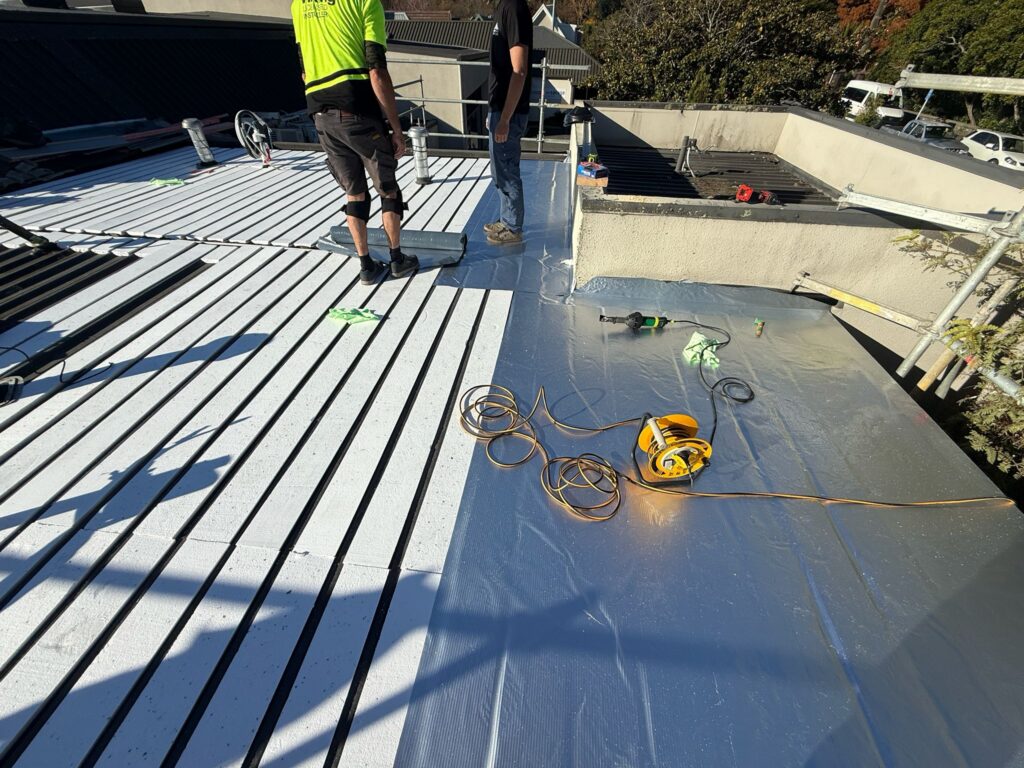
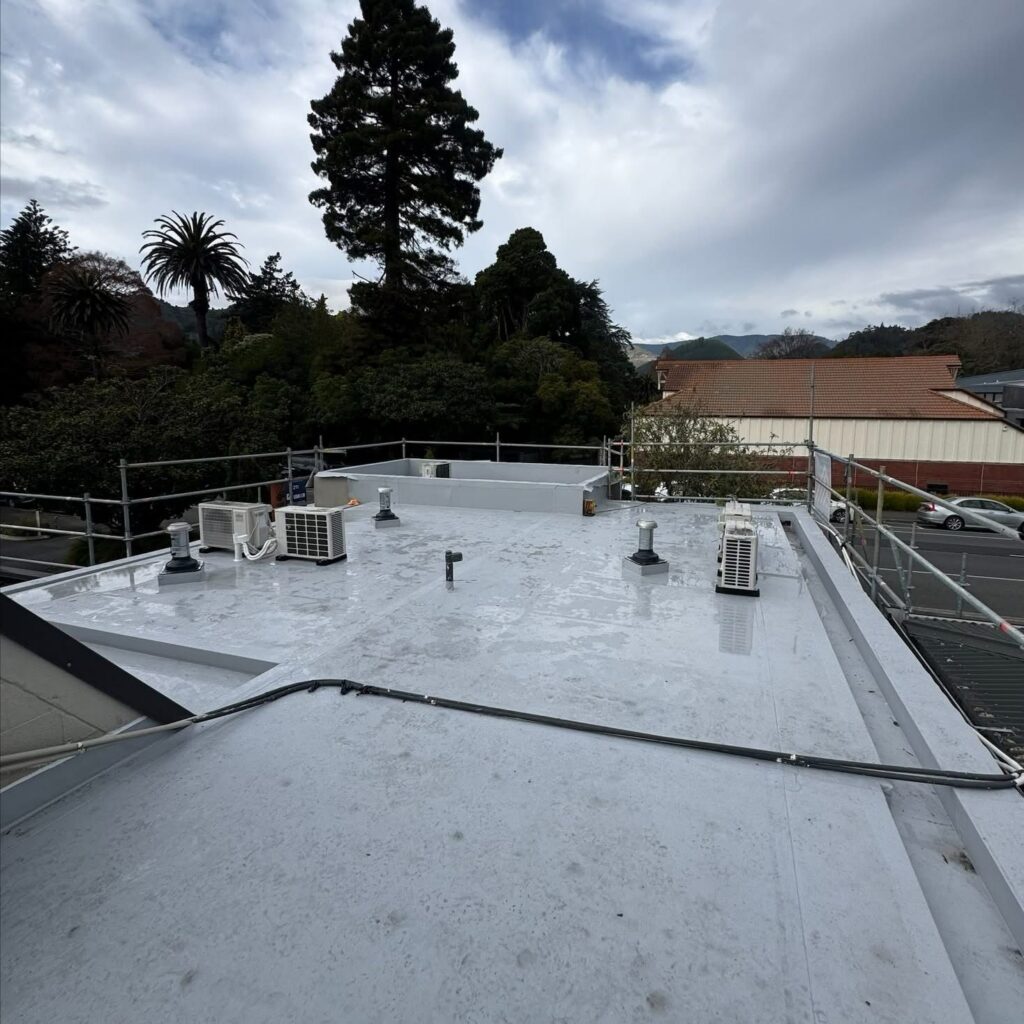
The images below show a recovery system completed by Roofing Masters Limited in Nelson, New Zealand, converting a trapezoidal-profile roof into a 110 mm insulated warm-roof system.
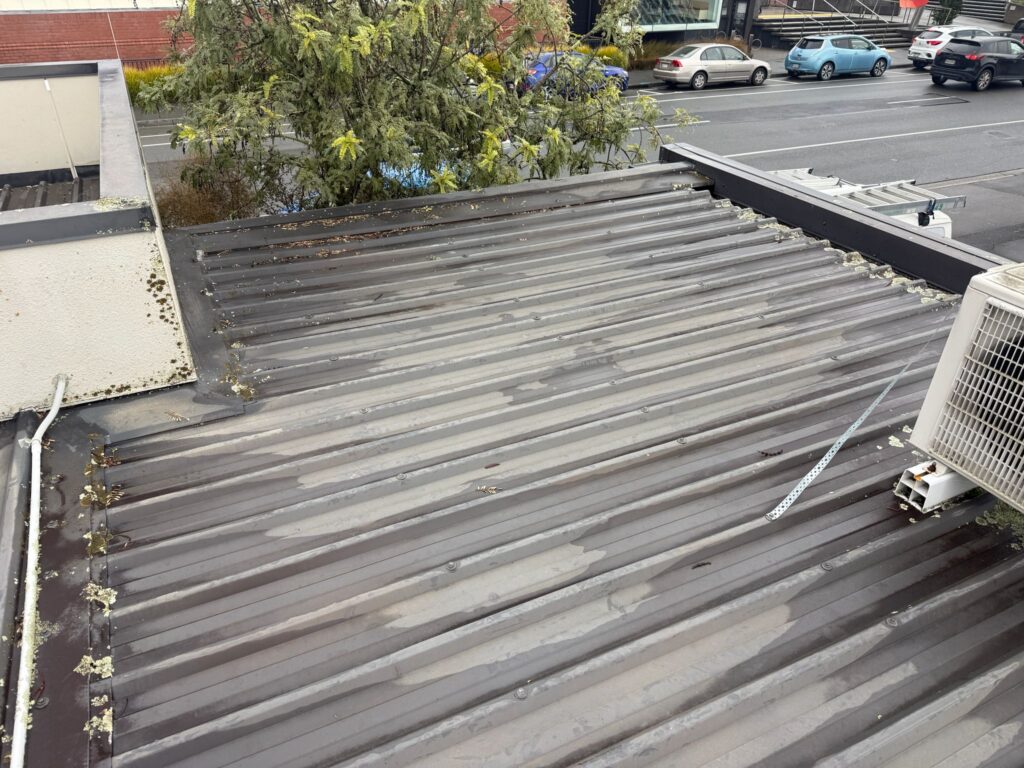
Existing trapezoidal roof profile before the overlay system was installed.
EPS fingers and vapour barrier membrane installed while keeping the building protected from weather exposure.
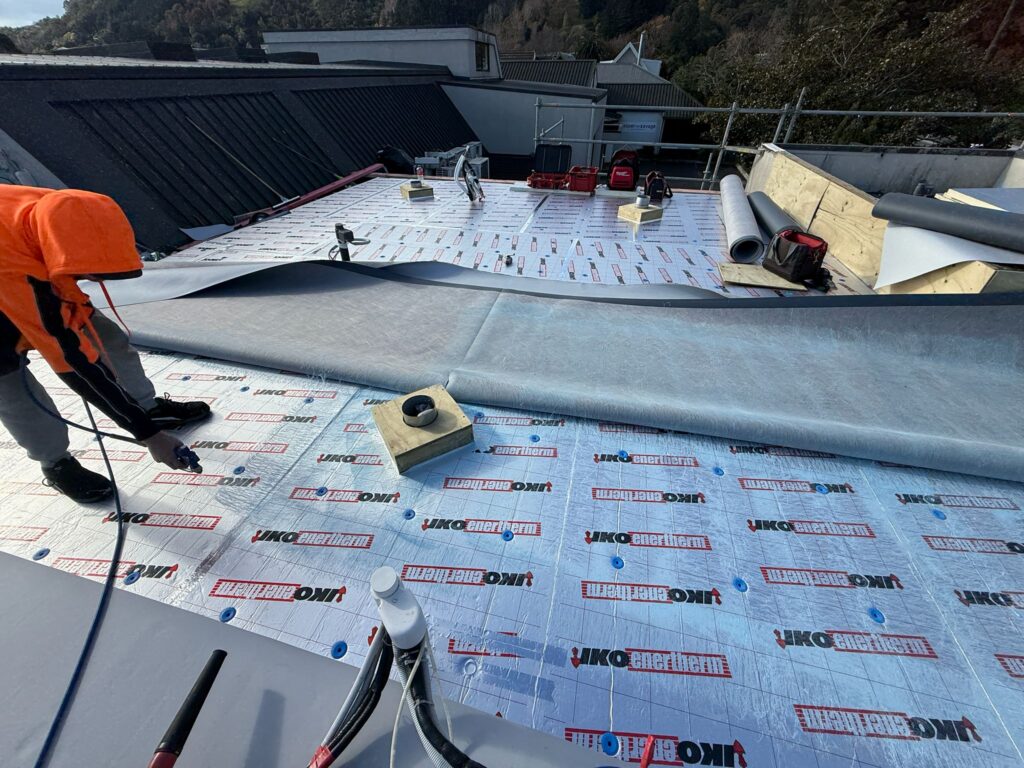
110 mm PIR insulation mechanically fixed with TPO fleece-back membrane installed across the full roof area.
The completed membrane roof delivers a clean finish and a durable long-term result.
Contact Roofing Masters Limited
If you are dealing with a low-pitch metal roof that continues to leak, or you are planning a new project and want to get the roof design right from the start, our membrane roofing specialists can help. Contact Roofing Masters Limited for practical advice, detailed inspections, and TPO or torch-on warm-roof solutions tailored to your building.